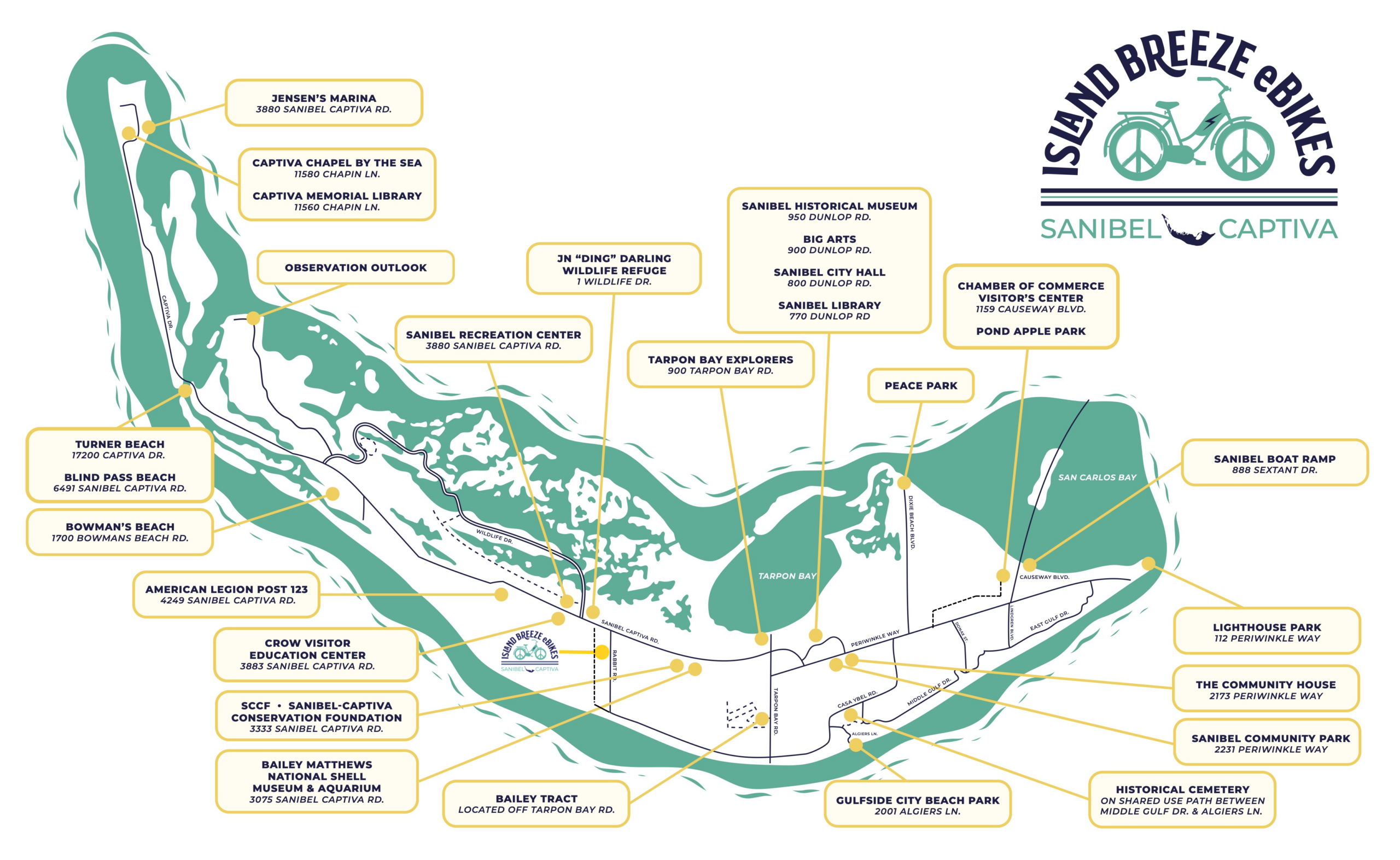
Every route starts from our Rabbit Road shop. Pick up an eBike and we'll point you in the right direction — or just follow one of these guides and discover the Islands at your own pace.
J.N. "Ding" Darling National Wildlife Refuge
From our Rabbit Road shop, turn right on the Shared Use Path and cross Sanibel-Captiva Road. Turn left and follow the path to the refuge entrance. Your first stop is the free Wildlife Education Center — worth a few minutes for the interactive exhibits on the refuge's ecosystems and the story of Jay Norwood "Ding" Darling, the Pulitzer Prize-winning cartoonist and conservationist who fought to protect this land. And don't miss the restrooms — the refuge's "Learning Lavatories" won the 2018 America's Best Restroom award, judged on cleanliness, visual appeal, innovation, and unique design. Stall doors are wrapped with professional wildlife photography and the walls feature an immersive underwater mural. Water bottle filling stations are just around the corner to the right of the main doors.
Then roll onto Wildlife Drive — a 4-mile, meandering ride through mangrove wetlands and subtropical hammock habitat. Stop wherever you like, pull over at the water's edge, and take it all in at your own pace. The refuge is home to more than 245 bird species — keep your eyes open for the signature Roseate Spoonbill, Osprey, Reddish Egret, and Yellow-crowned Night Heron. Alligators, bobcats, river otters, and land crabs call this place home too.
About halfway through, climb the Observation Tower overlooking the main bird-feeding area — one of the best wildlife viewing spots on the Island. (Here is where the iconic Roseate Spoonbill are most frequently seen.) Wildlife Drive is one-way, so at the end you'll exit back onto Sanibel-Captiva Road and return eastward along the Shared Use Path to the refuge entrance — a scenic ride in its own right, with the refuge stretching out beside you.
Ride out along Wildlife Drive and return via the Indigo Trail — a 3.7-mile loop that cuts back through the heart of the mangroves to the refuge entrance, avoiding the full 8-mile Wildlife Drive circuit.
Early morning at low tide brings the most bird activity and the coolest temperatures. Late afternoon and evening are equally magical: as the sun drops, large flocks of birds return across the sky to their rookery Islands, one of the great wildlife spectacles on Sanibel.
Entry fee is $1 per cyclist (ages 15 and under free). Wildlife Drive is open Saturday through Thursday — closed every Friday.
Blind Pass to Andy Rosse Lane
Whether you're rolling out of the Ding Darling refuge or heading straight down San-Cap Road from Island Breeze, this is the ride that takes you all the way to the end of the Islands. Follow the Shared Use Path westerly past Santiva, cross the small causeway at Blind Pass, and you've entered another world — a tropical resort hideaway that feels a universe away from the mainland.
Unlike Sanibel, Captiva has no separated bike path — just a narrow paved shoulder outside the traffic lines, so stay right and keep alert, especially where tropical vegetation crowds the road and where motorists slow down to catch a Gulf view. Captiva Drive heads north surrounded by trees with occasional glimpses of the Gulf and the bay, past the luxury estates of Millionaire's Row.
Along the way, stop at Jensen's Twin Palm Marina and make your way to the bayfront — scan for swirls in the water around the docks, the telltale sign of manatees just below the surface, and keep an eye out for brown pelicans, great white herons, and egrets. Just up the road, pause at the Chapel by the Sea — a small, simple chapel built in 1903 as a schoolhouse, now listed on the National Register of Historic Places. Next to it, a tiny cemetery holds the grave of William Herbert Binder, the Austrian who homesteaded Captiva in 1888 and spent his first ten years here entirely alone. It's one of those quietly moving spots that most visitors never find.
Continue north into Captiva Village and follow Andy Rosse Lane to the Gulf, where the iconic Mucky Duck awaits — a classic Gulfside spot with live music outdoors, perfect for a cold drink and a long look at the horizon. There's no better place to sit, breathe, and feel like you've truly arrived somewhere.
Captiva has no eBike rental of its own — Island Breeze delivers directly to Captiva guests. No car needed.
One of the World's Best Beaches
Whether you're returning from Captiva, rolling out of the Ding Darling refuge, or heading straight down San-Cap Road, turn at the firehouse and follow Bowman's Beach Road to one of the most celebrated beaches in the world, named by U.S. News & World Report as one of the Top 10 Beaches in the World, and by Condé Nast Traveler as among the Best Beaches in Florida. Those who've been here know why.
Park your bike at the racks and follow the path on foot, crossing Old Blindman's Pass — a peaceful mangrove-lined bayou — on wooden footbridges. Keep an eye out for alligators, manatees, and wading birds in the shallows below. When you reach the beach, turn right. The further you walk, the more the world falls away — no buildings, no concessions, no crowds. Just wide white sand, the sound of the Gulf, and shells as far as you can see. This is Sanibel as the Calusa Indians knew it for centuries.
Bowman's is a treasure trove for shellers, with some of the best shelling on the Island. Head far enough northwest along the shore and you'll reach secret Silver Key — a hidden tidal Island that emerges only at low tide and can be explored on foot when the water recedes. Best shelling is at low tide, especially after a westerly storm, when the sea delivers rare finds to the shore.
Bowman's is also a prime bird-watching spot, with frequent sightings of egrets, herons, osprey, and even bald eagles — and dolphins are often spotted just offshore.
Restrooms, showers, picnic areas, charcoal grills, a fitness station, and a playground are available at the park. No concessions on site — bring water and snacks. Parking is $5/hour by mobile app — but you're on a bike, so it's free.
History, Wildlife & Hidden Beaches
Head out the back of our plaza and take a left onto the Shared Use Path we call Alligator Alley — named for the resident alligators who keep watch from the water's edge. As with many parts of Florida wetlands, alligators are a part of the landscape. Don't stop to feed or approach them, and when you have a chance take a look at the City of Sanibel's brochure, Living With Alligators on Sanibel Island. Follow Alligator Alley to its end at West Gulf Drive, one of Sanibel's most beautiful residential stretches. Turn right and cruise along the Gulf side, stopping at the resident-parking beach access points along the way. Bike racks welcome all visitors at Beach Access Nos. 2 and 5.
Now head back the other direction (easterly) on West Gulf Drive, through the four-way stop at Tarpon Bay Road, to where the road bends past the graceful Casa Ybel Resort and becomes Casa Ybel Road. Turn onto Algiers Lane and take the Shared Use Path through a shaded tropical grove, where the path leads you to the historic Sanibel Pioneer Cemetery — one of the Island's most quietly moving spots, reachable only on foot or by bike.
The land was donated by the Reverend George Barnes' family near the turn of the 20th century as a public burial ground. It contains at least 31 graves, many unmarked, on a north and south ridge. The most notable marker belongs to Isaac Newton Rutland, who died in 1915 at age 23 — his tombstone, the tallest in the cemetery, was later used by aviators as a landmark to locate their approach to Casa Ybel's grass airstrip. The last burial here was a shrimper named Edmund Taylor in 1967. Stand quietly among the graves and you feel the full weight of Sanibel's pioneer past.
Turn back to Algiers Lane, take a left, and you'll arrive shortly at Gulfside City Beach Park — a lovely, uncrowded stretch of Gulf beach perfect for a rest before the ride back.
Restrooms available at Gulfside City Beach Park and at Tarpon Bay Beach Park. Parking is $5/hour by mobile app — but you're on a bike, so it's free.
Sanibel's Conservation Corridor
The stretch of Sanibel-Captiva Road between Tarpon Bay Road and the Sanibel Recreation Center now has an official name — the Wild Mile — and it earns it. Four of Sanibel's most beloved conservation non-profits are located within about a mile of each other along this beautiful, substantially undeveloped stretch of Sanibel-Captiva Road and the Island-wide bike path. You could spend an hour here or an entire day.
Start at Tarpon Bay Explorers at the eastern end, where you can rent a kayak and paddle the meandering mangrove waterways of the J.N. "Ding" Darling refuge — one of the most peaceful ways to experience the Island's wild interior. Then pedal west to the Bailey-Matthews National Shell Museum & Aquarium — the only museum in the United States devoted entirely to shells and the creatures that make them. The Museum's collection includes some 550,000 shells, displayed in the Great Hall of Shells, and the Living Gallery of Aquariums showcases over 60 species of marine life — including a Giant Pacific Octopus, Giant Clams, Horse Conchs, touch pools, and daily talks by marine biologists. It's surprisingly fascinating, and a perfect stop for families.
Continue west to the Sanibel-Captiva Conservation Foundation (SCCF), created by islanders in 1967 to protect and care for the Island's unique ecosystems, with more than 8 miles of trails across the Island and voluntourism opportunities to restore and protect native habitats. Just beyond, stop in at the J.N. "Ding" Darling Wildlife Visitor & Education Center — free admission, and a worthwhile introduction to the refuge even if you're not riding the full Wildlife Drive today.
End your Wild Mile ride at CROW — the Clinic for the Rehabilitation of Wildlife — a working wildlife hospital that cares for injured and orphaned native animals. Visitors can tour the facility and see the animals currently in rehabilitation. Clinic tours start at 11:00 a.m. — worth timing your ride to catch one.
Finish with a swim or a workout at the Sanibel Recreation Center, right at the western end of the Wild Mile, before heading back to Island Breeze.
Download the free Sanibel Wild Mile Passport at SanibelWildMile.com — check in at each location to earn points and prizes. No app required.
Boutiques, History & Lighthouse Beach
This is the ride that takes you through the heart of Sanibel — past the Island's best boutique shopping, down a shaded nature detour, and all the way to its most iconic landmark.
Head east from Island Breeze along the Shared Use Path on San-Cap Road until it winds to Periwinkle Way, Sanibel's charming main thoroughfare. The path is separated from traffic, so you can browse as you roll. Stop by On Island at the Village Shops, Sanibellians' favorite store. Check out the boutiques at the Periwinkle Place Shops, where the very first Chico’s opened its doors; continue to the Shops at Tahitian Gardens, Jerry’s Plaza, and the Heart of the Island Shops. Far from a typical tourist strip, Periwinkle's boutiques wind through Sanibel's commercial thoroughfare — local, independent, spirited, and worth a wander.
Before continuing east, take a detour north on the Shipley Trail, past Bailey's Homestead and the SCCF Native Landscapes & Garden Center. Continue onto the Pond Apple Trail through a shaded native hammock until it delivers you to the Sanibel Visitor Center — a peaceful inland ride through some of the Island's least-visited green space. Turn around and head back down to Periwinkle, then continue east all the way to the end of the Island.
Your destination is the Sanibel Lighthouse — the Island's most beloved landmark and the natural endpoint of any Island ride. Construction began in February 1884, funded by a $50,000 Congressional appropriation, and the lighthouse was lit for the first time on August 20, 1884 — making it the first lighthouse in Florida north of the Florida Keys. Remarkably, while being built, the ship carrying the steel for the structure sank two miles from Sanibel Island — divers salvaged all but two pieces. The lighthouse was added to the National Register of Historic Places in 1974 and still guides mariners today. The lighthouse lost one of its legs and both of its keepers’ cottages during Hurricane Ian in 2022, and was re-lit in a joyous ceremony five months later. Lock your bike, walk the grounds, and take in Lighthouse Beach — one of the finest stretches of sand on the Island, with excellent shelling and a fishing pier.
Restrooms, outdoor showers, picnic pavilions, and bike racks are available at Lighthouse Beach Park. Parking is $5/hour by mobile app — but you're on a bike, so it's free.
975 Rabbit Rd, Suite 6B, Sanibel FL